
Docker infrastructure audit: 74 containers, patches for 12 projects and 13 successful builds
I prepared PHP security changes for several projects sharing a Docker server. Preserving live services and producing verifiable candidate builds before any rollout decision were essential constraints.
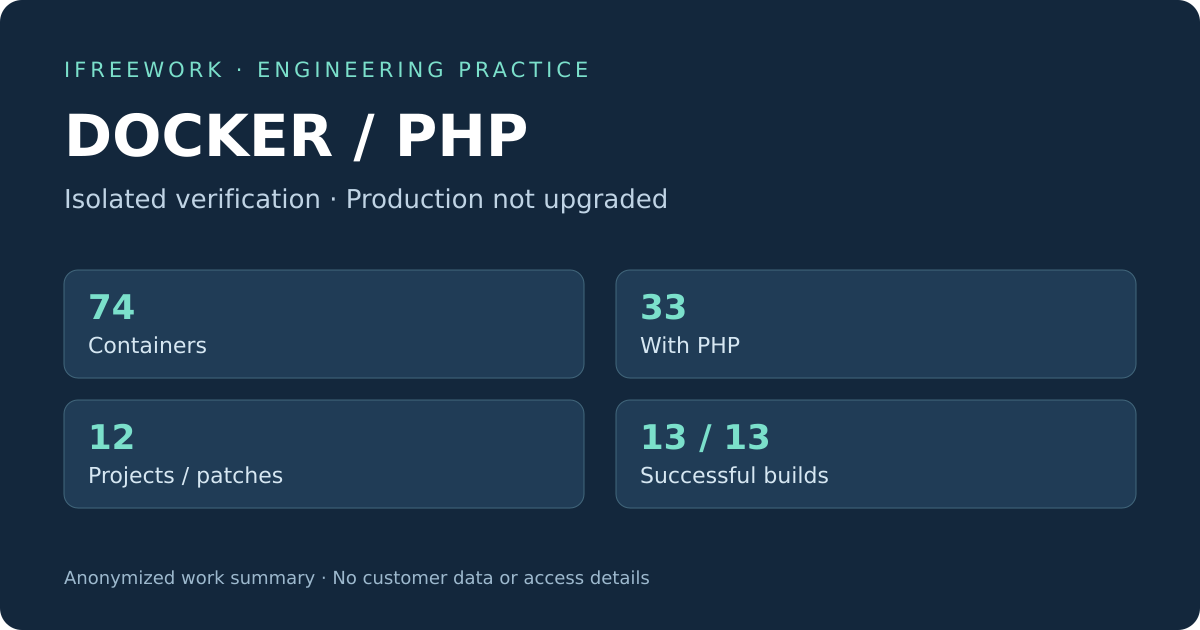
Inventory before changes
I checked actual runtimes, images and extensions. Applications, workers, scheduler and a separate phpMyAdmin image required different verification paths. Prepared changes remained separate from original production Dockerfiles and configuration.
Candidate images and compatibility
Security patches were prepared for 12 projects, with phpMyAdmin as a separate build target. All 13 runtime/image targets built successfully. Nine Laravel copies passed platform requirements, lint, CLI boot and strict HTTP health checks.
PHP and application
Checks covered actual runtime versions, retained modules and application boot. HTTP 200 alone was insufficient without the expected response.
Data and background work
SQLite, isolated MariaDB/MySQL, Redis where applicable, and synthetic worker/scheduler tasks.
Specialized checks
A relevant WebSocket handshake plus HTTP/database checks for the separate phpMyAdmin image.
Isolation
Separate contexts and test data without production volumes, secrets or real business jobs.
What remained unchanged
All 74 original container/image IDs and the source Dockerfiles were preserved. No commit, push or production deployment was performed for this package, and no containers were manually restarted.
Three workers showed the expected hourly lifecycle. The report states this rather than claiming no restarts at all. Resource usage was bounded; zero latency impact was not independently measured.
Limits and residual risk
The package did not test full business workflows, production routing, real external services or existing queue contents. PHP patches do not automatically resolve all dependency/system advisories. Unsupported legacy stacks require a separate decision.
Outcome: ready for review
The deliverable is candidate patches, images and the listed smoke/integration results. It establishes review readiness, not completed production deployment.
Rollout still requires verified backup/rollback readiness, a maintenance window, business checks and separate authorization to update applications and background services.
Frequently asked questions
Why were the patches not deployed immediately?
The agreed scope covered preparation and verification; production deployment required separate approval.
What matters before updating workers?
Application compatibility, queue behavior, in-flight jobs, startup configuration and rollback criteria. This package did not process real business jobs.
Services, article and documented case studies
Related services and technical reading
Website and server migrationPlanning migration, backups, verification and rollback.