
Fragment Radar: Monitoring Telegram Collectibles
Case · Fragment · Telegram Collectibles · Laravel · 2026
In the microservice GRAM added Fragment Radar — read-only surveillance circuit Telegram usernames and anonymous numbers +888. It collects public Fragment data, classifies assets, preserves auction history and helps to quickly find interesting lots on the transparent Radar Score.
In short: Fragment Radar turns viewing of the marketplace into a reproducible research process. Instead of manually combing through pages, a single database, filters, change history, pattern features, and an explainable ranking from 0 to 100.
Why you need a separate Radar
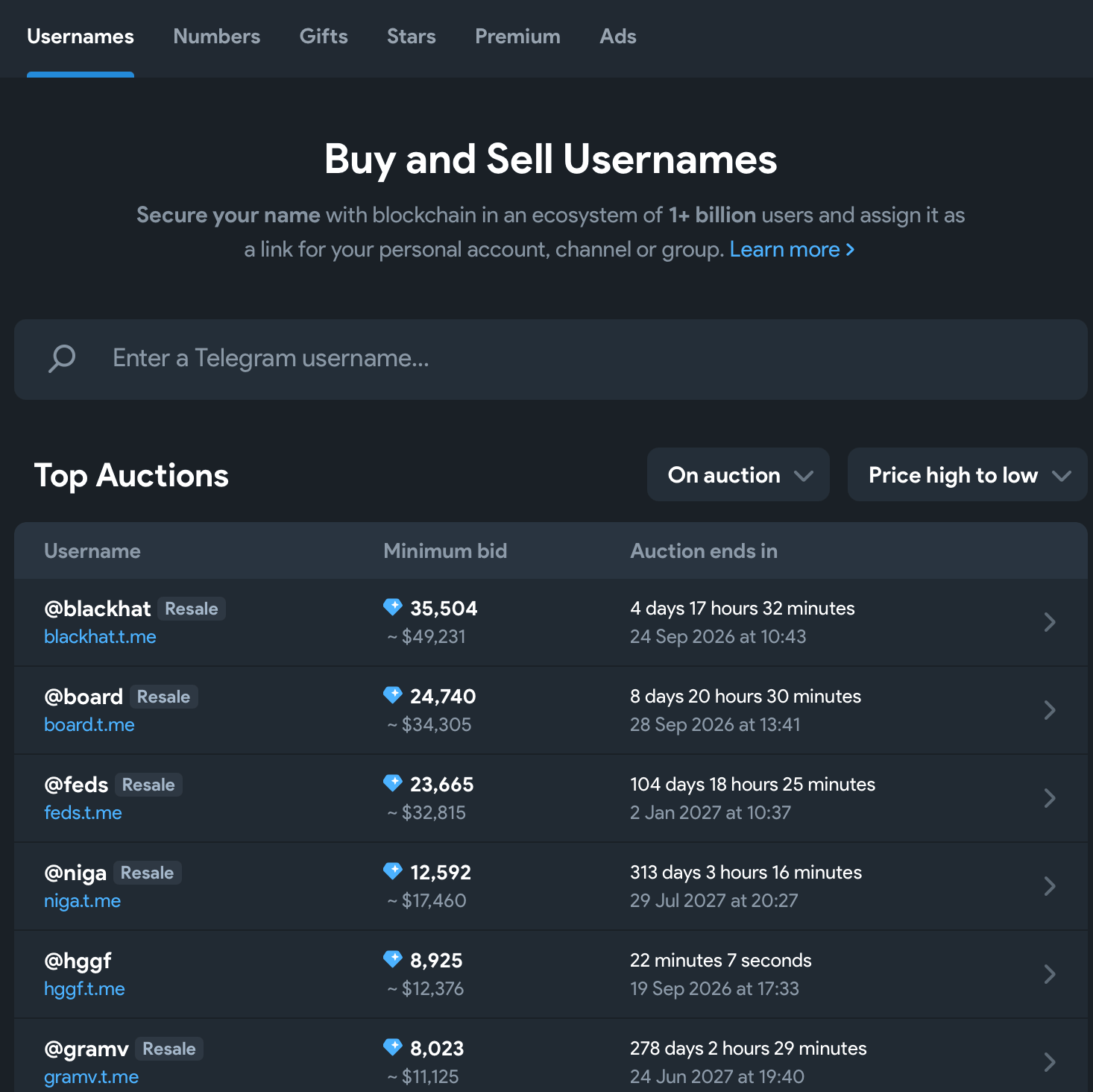
Nana Fragment At the same time, new usernames and numbers appear, prices, rates and auction terms change. The marketplace interface is well suited for a separate purchase, but does not answer research questions: what patterns are more common, how the price changes, what appeared per day and what auctions will soon end.
Therefore, a separate analytical layer appeared in GRAM. He regularly reads open pages, normalizes the found lots and stores their changes over time. This is a continuation of the already implemented blockchain-circuit: wallets and payment transactions GRAM are described in this article. Project P2P platformand the release of NFT in Case TON NFT.
Main Frontier: Reading Only
Radar does not log in to Fragment, does not connect a Telegram account, and does not access the wallet. The provider does not have methods for betting, buying or transferring an asset. It performs only public requests that are needed to search and read the lot card.
What the module does
- Finds usernames and numbers
- updates the status of auctions
- fix the price, rates and deadline
- saves snapshots and events
- calculates the structural score
What the module doesn't do
- stakeless
- don't buy
- Does not sign TON transactions
- does not store user sessions
- yieldless
This separation is important both in terms of security and data quality: analytics should not become a trading bot.
How public data is collected
Fragment uses short-lived hash and cookie sessions. Therefore, the provider first opens the public page, extracts the current parameters, and then refers to the same JSON endpoint search, which uses the web interface. The detailed card is downloaded separately and disassembled by the HTML parser.
Discovery
Search queries find usernames and numbers. Each result gets a stable type, value, slug and public URL.
public search · normalizeClassification
Individual classifiers calculate features: length, numbers, repetitions, sequences, symmetry and dictionary matches.
features · tags · categoriesRefresh
Background jobs update the price, next bet step, number of bets, status and time of completion of the auction.
queue · staggered jobsHistory
The new snapshot is only created when the state changes. Comparison generates one-time domain events.
snapshots · eventsResearch
Adminka combines filters, sorting, asset card, history and decryption of score.
filters · score breakdown
Primary set: 2 630 assets
At the time of fixing the case, the primary scan collected 2 630 unique assets: 1 500 usernames and 1 130 numbers. Among them, lots are recorded in the states of auction, resale, sale and sold. This set already allows you to check the classification and interface, but is not yet sufficient history for market conclusions.
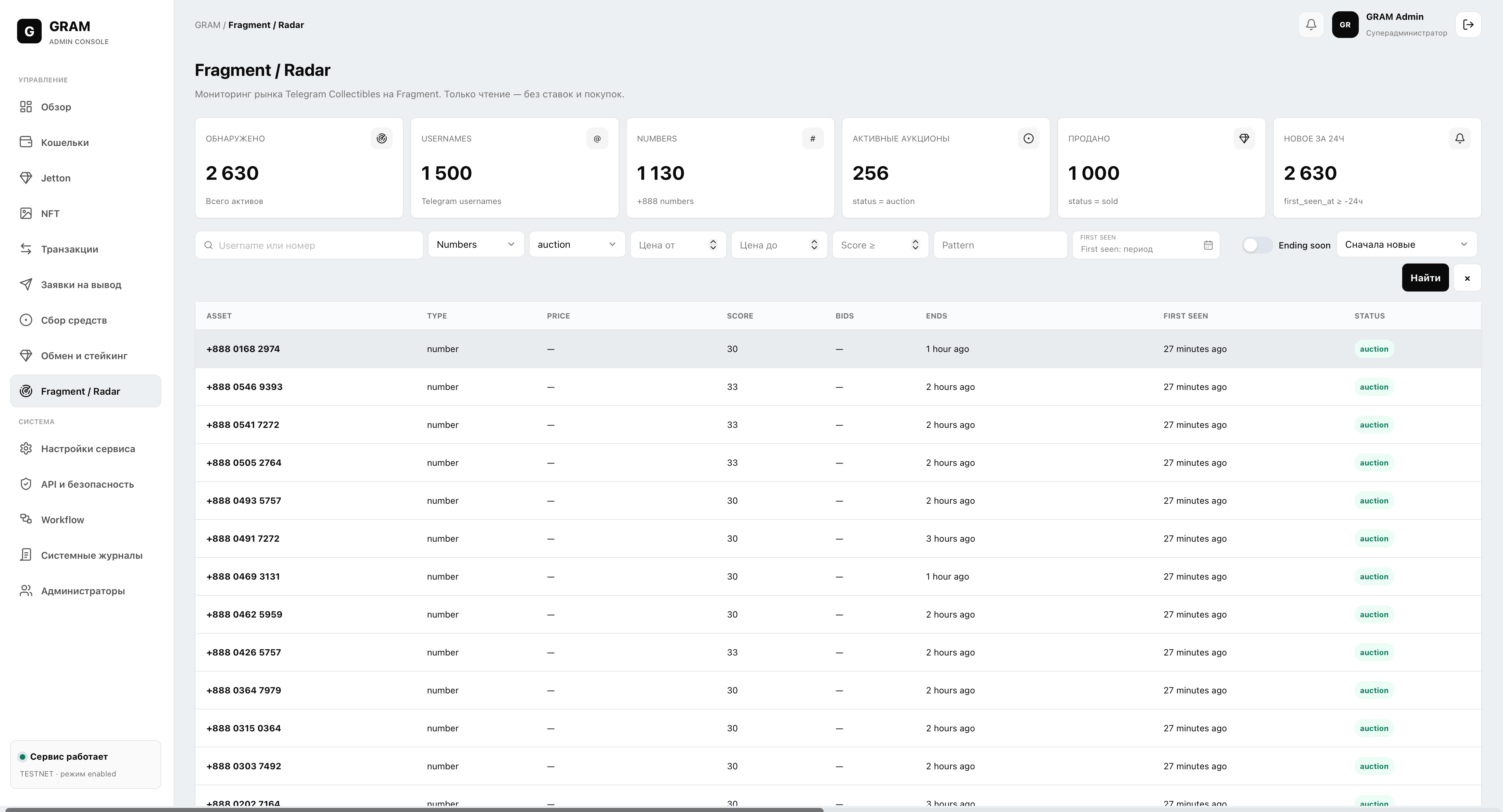
Continuous mode is controlled by a separate feature flag. While it's off, the scheduler doesn't address Fragment. This allows you to first apply migrations, check the queue and limits, and then turn on regular surveillance without changing the code.
Two Classifications for Different Asset Types
Username and the number cannot be valued by a single formula. For a short word, length, character composition and dictionary coincidence are important. For the number - repeating numbers, sequences, mirror, palindrome and round ending.
Telegram usernames
- length and number
- alphabetic, digital or mixed composition
- emphasis
- repeat
- dictionary
Anonymous numbers
- number
- repeater
- increasing and decreasing sequences
- mirroriness
- round-end
Results are stored as separate features, categories and tags. Therefore, the formula can be changed, and the initial observations remain available for recalculation.
Radar Score: Rating that can be explained
Each asset receives score from 0 to 100. For numbers, the rarity of numbers, repetitions, sequences, symmetry and length are weighed. For usernames, length, dictionary match, character composition, number of digits, and noticeable pattern.
The database stores not only the result, but also breakdown: the value of each factor, its weight and contribution. The formula has a version, so after adjusting the weights, you can recalculate the entire set by the team. fragment:score:recalculate and maintain a clear methodology.
Important: Radar Score is not a future price estimate or a financial recommendation. It is a heuristic indicator of structural expressiveness, designed for sorting and primary selection.
Snapshots and events instead of overwriting a line
The current state is needed by the interface, but transitions are more important for analysis. Therefore, the state of the lot is compared with the last observation. If nothing has changed, no duplicate snapshot will be created. If it has changed, a new slice and the corresponding event are saved.
The life cycle
NEWThe asset was first foundSOLD- recorded saleEXPIREDThe auction is completed without saleREMOVED- the lot disappeared from issuance
Dynamics of the auction
PRICE_CHANGEDThe price has changed.BID_CHANGEDThere's a new bet.ENDING_SOONThe deadline entered the predetermined window.
Disposable events are protected from re-creation. This makes future notifications and reports predictable: one state transition corresponds to one event.
Filters and asset card in adminka
The list can be filtered by type, status, price range, minimum score, pattern, first detection time, and near completion. Available sorting by price, score, number of bets, deadline, activity and time of addition.
The asset card shows the reference to Fragment, the price in TON, the approximate equivalent in USD, the next step, the history of snapshots and events, the characteristics of the classifier and the full breakdown Radar Score. The TON/USD recalculation is rarely performed and is used only for indicative display.
Lines, Limits, and Recovery from Errors
Discovery and refresh operate via Redis Queue. Updates are distributed over time so that multiple tasks do not create a spike in requests. A minimum interval is kept between calls, and 429 is turned on when cooldown is answered.
Each request of the provider falls into the technical log: HTTP status, delay, number of elements, rate limit sign or lock and error text. This makes it possible to distinguish the Fragment markup change from network failure and from constraint triggering.
The scheduler supports separate intervals: discovery - usually once in 15 minutes, refresh auctions - every 5 minutes, updating the indicative course TON/USD - every 3 hours. Tasks are protected from overlap and are executed by a single scheduler node.
From data accumulation to analytics
Team. fragment:dataset:report generates a reproducible report: number of unique assets, new and completed lots, sales, range of observed prices, price change, frequency of patterns, average auction duration and distribution of score.
For meaningful comparisons, a time series is needed. The minimum window is seven days, preferably fourteen or more. Prior to the accumulation of this period, the figures in the panel confirm the performance of pipeline, but should not be interpreted as a statistical market model.
The result
Fragment Radar has added a stand-alone read-only Telegram Collectibles study module to GRAM. Public data goes from discovery to normalization, classification, versioned score, snapshots and events, and then becomes available in a convenient administrative panel.
The architecture is designed for safe development: collection is included with a separate flag, requests are limited, errors are logged, the state is stored historically, and the formula can be recalculated without loss of original features. The next practical step is to accumulate a time series and calibrate weights at real completed auctions.
Laravel · PHP · Fragment · Telegram Collectibles · TON · Redis Queue · Docker · Data Pipeline