
AI Beauty Booking SaaS Architecture
Architecture case study · AI-native SaaS · Booking · CRM · 2026
An AI-native SaaS for beauty professionals and teams. Public booking, CRM, scheduling, acquisition attribution and AI-assisted workflows share a deterministic booking core and an explicit tenant boundary.
Architecture rule: deterministic core, probabilistic edge. AI extracts, interprets and drafts; availability, booking, authorization, billing and lifecycle remain testable application logic.
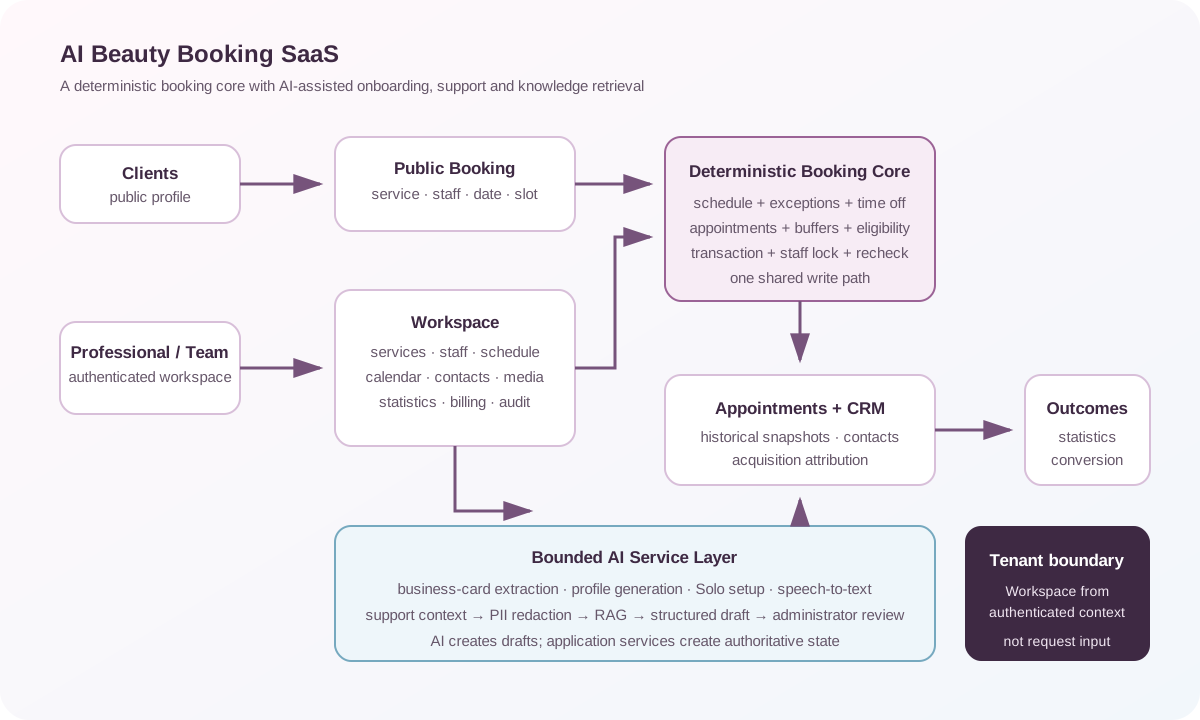
More than a calendar: an AI-native business application
A client books through a public profile while a professional or team manages services, staff, schedules, contacts, calendar and statistics inside one Workspace. Appointments and CRM records retain acquisition attribution, so the system measures channel outcomes rather than only occupied slots.
AI reduces onboarding data entry, assists profile and setup creation, transcribes speech and drafts support replies from product knowledge. Each capability uses provider contracts and structured drafts; authoritative state is established by application services after review.
AI-native onboarding
Business card, text or audio
The user can start from existing material instead of completing every field from scratch.
inputExtraction and interpretation
AI extracts supported business data or interprets a Solo professional's natural-language description.
AI edgeStructured draft
The output follows a schema for profiles, services and working context, but is not yet business truth.
draftUser review
The owner confirms or corrects the proposal. A temporary card image does not become a permanent source of business data.
human reviewApplication services
Conventional services validate commands and create the Workspace, profile and services.
authoritative statePublic booking profile
The accepted configuration becomes the client-facing booking entry point.
outcome
The deterministic booking engine
An LLM cannot own slot availability. The answer must consistently combine weekly schedules, date exceptions, custom availability, time off, existing appointments, service duration and buffers.
Availability calculation
The rules form a 15-minute grid. Eligibility removes intervals that do not fit the service, professional or current schedule state.
One write path
Public and manual booking invoke the same application service, so a second interface cannot bypass policy.
Transaction and staff lock
The professional is locked for the critical operation, availability is recalculated, and only then is the appointment created.
Concurrency defense
Database constraints complement application overlap checks so concurrent requests cannot occupy the same slot.
Historical integrity
An appointment snapshots service name, duration, buffers, price, currency and client contact details. Renaming a service, changing its price or deleting a current contact never rewrites what an earlier appointment represented.
Workspace as the tenant root
Staff, services, locations, contacts, appointments, schedules, media, notifications and audit data are scoped to a Workspace. Tenant identity comes from authenticated context; an arbitrary workspace ID from a request is never trusted.
Solo
One canonical professional, AI-assisted setup, services, availability, calendar and a simplified operating flow.
Team
Multiple professionals, service qualification, independent schedules, a shared Workspace, staff selection during booking and business-wide statistics.
Support AI and RAG with mandatory review
Bounded context
A ticket receives only relevant audit events, recent application errors, onboarding diagnostics, AI-generation state, delivery state and a Workspace snapshot.
PII redaction
Sensitive values are removed or masked before model use.
Knowledge retrieval
Embeddings select relevant fragments from product help knowledge.
Structured draft and validation
The response passes schema and source validation while retaining diagnostic metadata.
Administrator review
An administrator verifies and sends the reply. AI support drafts are never sent to customers automatically.
Attribution from source to business outcome
An acquisition event can flow through visitor, client, appointment and professional. Booking therefore becomes a measurement layer for acquisition source, new-client conversion, appointments by professional and appointment lifecycle.
The purpose is to measure the business outcome of a channel, not merely visits or submitted forms.
The AI authority boundary
| Deterministic core | AI-assisted edge |
|---|---|
| Availability and booking | Business-card extraction |
| Tenant authorization | Profile generation |
| Billing and schedule conflicts | Solo setup interpretation |
| Appointment lifecycle | Speech-to-text |
| Transactions and constraints | Support drafts and knowledge retrieval |
Current implementation status
| Capability | Status |
|---|---|
| Multi-tenant core, Solo onboarding and calendar | Implemented |
| Team model and staff scheduling | Implemented |
| Public booking engine and client CRM | Implemented |
| Acquisition attribution, statistics and billing ledger | Implemented |
| Business Card AI, Profile AI and Solo Setup AI | Implemented |
| Support drafts and knowledge retrieval / RAG | Implemented |
| Social / client-discovery automation | Planned product stage |
| AI-driven outbound acquisition | Planned product stage |
Technology
Result
The result is a production-oriented SaaS architecture where AI accelerates setup and support without owning critical booking rules. The booking core remains transactional and reproducible, while Workspace provides an explicit data boundary for every tenant.
AI-native SaaS · Booking · CRM · Laravel · MariaDB · Vue · LLM · RAG · Human-in-the-loop