
KINOSOCHINENIE: an AI Telegram bot for educators
Case study · Python · Telegram · OpenAI API · Education
KINOSOCHINENIE is an AI-powered Telegram bot for educators who use film and video production in their classes. It helps prepare creative activities, plan lessons, explore smartphone filmmaking and ask a virtual teaching adviser questions.
My work on this project covered the Python backend, Telegram commands, OpenAI API integration and request history storage. The completed project cost $300.
The task: help educators prepare film-based lessons
An educator needs a convenient way to turn an initial idea into a lesson plan and activities for children. Telegram provides a familiar interface for choosing a topic, asking a question and continuing the discussion without a separate website.
The bot combines a topic menu with a language-model conversation. AI produces a draft and suggestions; the educator reviews the material and adapts it to the participants’ age and classroom conditions.
Features shown in the bot
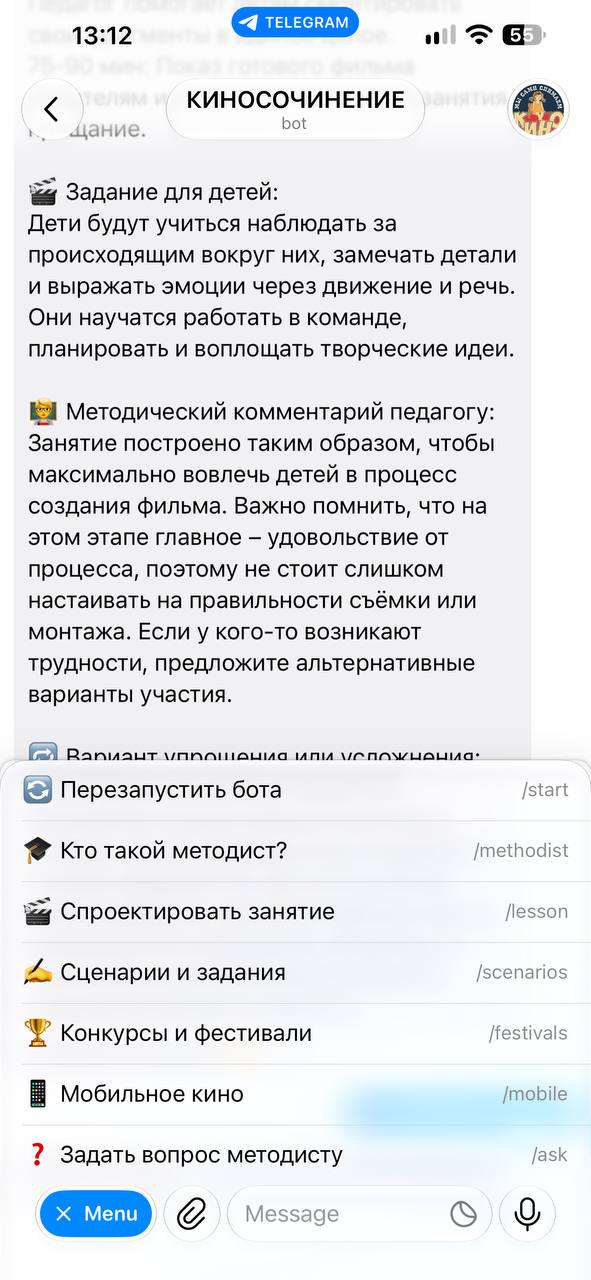
- Lesson planningThe
/lessoncommand opens the relevant workflow. The sample response includes an activity for children, teaching notes and ways to adjust its difficulty. - Scenarios and activitiesThe menu has a dedicated
/scenariossection for creative materials. Users can choose a task-specific workflow instead of starting with an unstructured chat. - Smartphone filmmakingThe
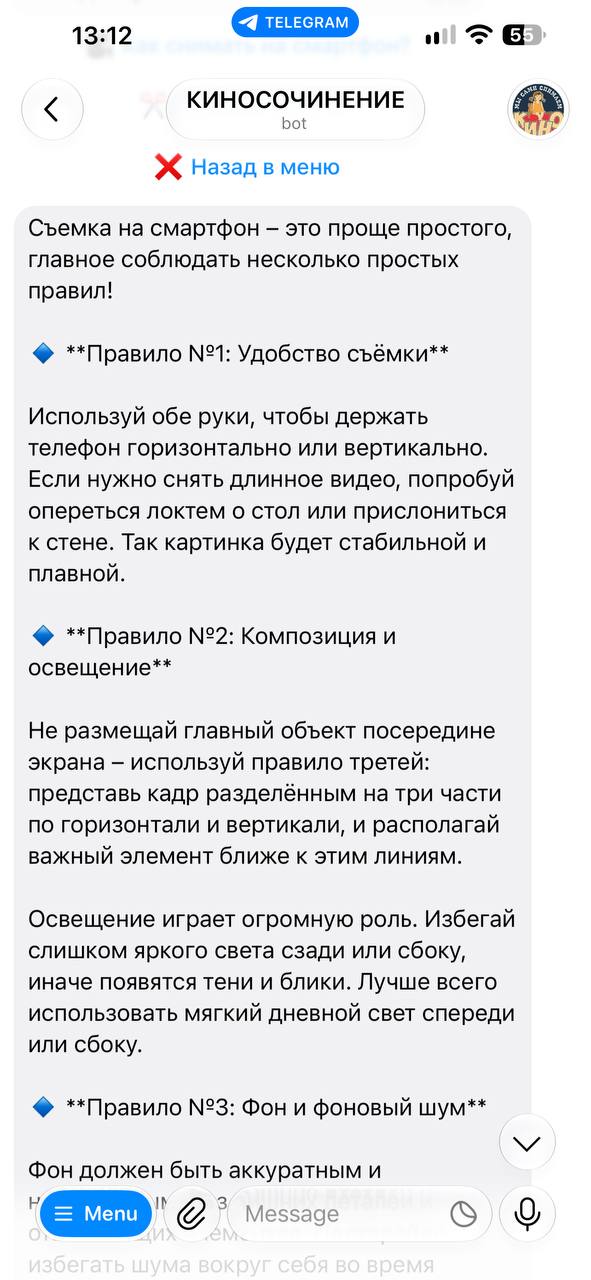
/mobilesection offers guidance on phone positioning, composition, lighting and background noise. - Questions for a teaching adviserThe
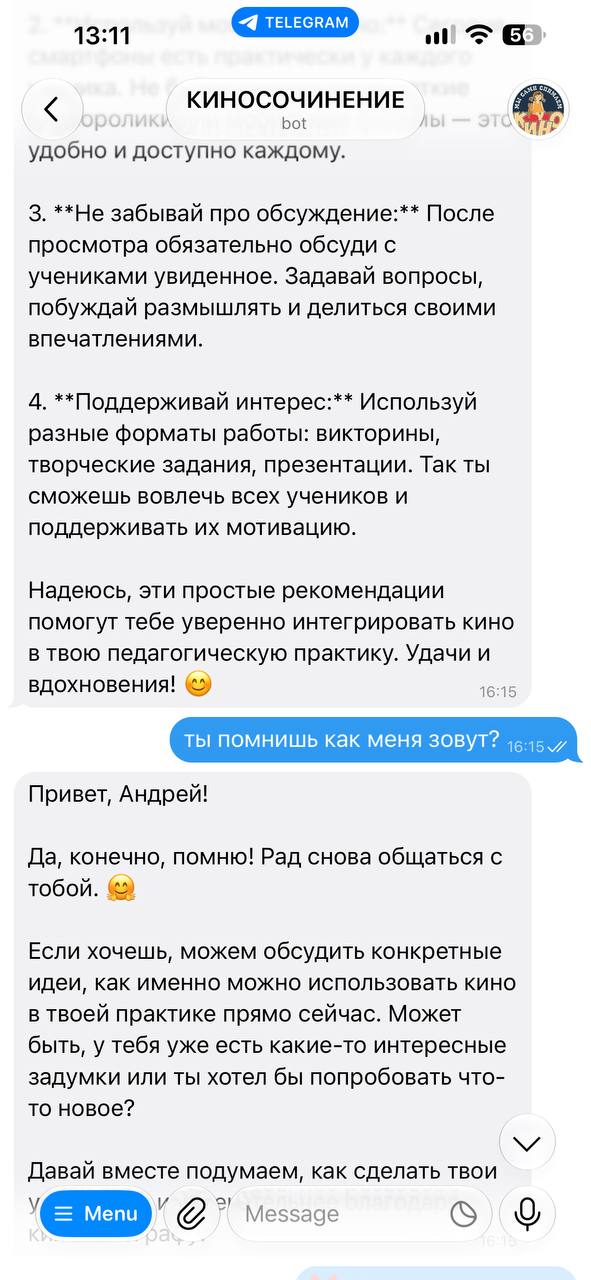
/methodistand/askcommands introduce the assistant and allow open questions. In the supplied conversation, the bot uses the name the user shared earlier.
The menu also includes contests and festivals through /festivals, restarting with /start and returning to the menu. A dedicated section does not imply live verification of dates: users should check current details with organisers.
Architecture and request processing
Telegram and Aiogram 3 handlers
A user sends a command or message. The Python application receives the event through the Telegram Bot API, identifies the selected workflow and prepares its input.
Task-specific AI instructions
The request to OpenAI includes the user’s input and instructions for the chosen task. These define the assistant’s role and response structure, such as a creative activity followed by teaching notes. The project uses the OpenAI API with GPT-4 / GPT-4 Turbo models.
History and settings
SQLAlchemy connects the application to SQLite, which stores request history and user settings. Conversation context supports follow-up questions; it does not give the model unlimited memory.
Deployment
The application runs in Docker on an Ubuntu VPS. Telegram provides the interface, Python handles workflows and integration, OpenAI generates text, and SQLite stores application data locally.
This is a Telegram integration with a language model. A separate vector search system, RAG knowledge base and fact-checking against external film databases are outside the scope described here.
Technology stack
| Component | Technology |
|---|---|
| Backend | Python 3.10+ |
| Telegram Bot Framework | Aiogram 3 |
| AI / LLM | OpenAI API (GPT-4 / GPT-4 Turbo) |
| ORM | SQLAlchemy |
| Database | SQLite |
| Containerisation | Docker |
| Infrastructure | VPS, Ubuntu |
KINOSOCHINENIE in use
The screenshots show the bot’s Russian-language interface and example responses. Recommendations are generated by the model and should be reviewed by an educator before use.
Outcome and scope
The result is a topic-focused AI assistant in Telegram with commands for lesson preparation, creative activities and filmmaking advice. The examples demonstrate structured teaching suggestions and follow-up conversation.
The bot helps prepare material but does not replace an educator’s judgement or fact-checking. No percentage of time saved is claimed: this case study does not include a separate time-saving measurement. Data retention and deletion, request limits and ongoing support are agreed for each deployment.
Development cost
The completed KINOSOCHINENIE project cost $300.
This amount applies to this specific case and its scope. The cost of a similar solution depends on features, external integrations, data requirements and architectural complexity. $300 is not a fixed price for every AI-powered Telegram bot.
For a new project, development, API usage, hosting and ongoing support are scoped separately.
Frequently asked questions
How much does an AI-powered Telegram bot cost?
The completed KINOSOCHINENIE project cost $300. Other bots are priced according to their workflows, integrations, data handling and deployment requirements. This price does not automatically apply to other projects.
Which AI models can be connected to a Telegram bot?
This project uses the OpenAI API with GPT-4 / GPT-4 Turbo. Another model can be integrated if its provider offers a suitable API. Request formats, response quality, limits and usage costs need to be checked for that integration.
Can a similar bot be built for a different subject?
Yes. Commands, workflows, model instructions and response review criteria are adapted to the new subject. For example, an assistant could support another school subject. The adaptation is scoped before development begins.
Where are user data and request history stored?
In this project, request history and user settings are stored in SQLite on the application server, accessed through SQLAlchemy. Messages pass through Telegram, and the data needed to generate a response is sent to the OpenAI API. Retention, deletion and backup rules need to be defined for each deployment.
Can the bot be extended after launch?
Yes. New commands, workflows and integrations can be added, or data storage can be changed. Existing behaviour and compatibility are reviewed before implementation. Database migration or adding RAG is estimated separately.
Does the bot verify every answer?
Language models can make mistakes. This case does not claim automatic verification of all answers against external sources. A person should review teaching material, factual statements and contest requirements before using them.
Build a similar solution
The work is carried out by Andrey Zubar, an independent Senior Backend Developer. For an estimate, describe the audience, main commands, required integrations and conversation history requirements.
Telegram bot and Mini App developmentWorkflows, backend development and external API integrations.
More AI integration and RAG case studiesSolutions with different goals and architectures.