
How Bybit’s Support Bot Turned a Simple Issue into an Endless Conversation
First-hand experience · AI support · P2P · case management
A buyer marked a P2P order as paid, but no money arrived. While my cryptocurrency remained locked, support suggested actions already taken or currently unavailable. This case illustrates what automation needs to carry a request through to a result.
The main problem: replies arrived, but the case did not progress. Even reaching a human agent did not ensure that the investigation would continue after the chat disconnected.
Two support experiences while developing a CRM AI agent
I encountered these support problems while developing AI Sales Agent, an AI agent for CRM. First came the attempt to transfer a balance between a hosting provider’s products, described in “AI bots in technical support”: the case moved between participants, I had to repeat the context, and fast replies did not lead to a fast resolution.
The Bybit situation described here happened later: a cancellation request already existed, an appeal was unavailable, and reaching a human agent was followed by a return to the beginning of the conversation. Both experiences reminded me as a developer that task state, context handoffs, and outcome verification need explicit design.
What happened to the order
On October 30, 2026, I was selling 59.9608 USDT for UAH 2,760 through Bybit P2P. The buyer confirmed payment, although no money had arrived in my bank account. I requested cancellation and selected non-payment as the reason.
The interface said the buyer had almost 24 hours to review the request. The option to open an appeal was disabled during that waiting period. My cryptocurrency remained locked, and the buyer could leave the request unanswered for almost a day.
- No payment receivedThe transfer was absent from my bank account.
- Cancellation already requestedAnother instruction to cancel the order did not provide a next step.
- Appeal unavailableThe interface did not allow an appeal while cancellation was pending.
- Funds remained lockedI contacted support to have the situation reviewed and the unpaid order cancelled sooner.
According to information I received during the interaction, this type of cancellation also did not affect the buyer’s order completion rate. This describes a specific case; it is not a verification of the exchange’s general rules.
How support sent me back to the beginning
An instruction instead of a next step
The bot suggested requesting cancellation. I explained that a request already existed. It later recommended opening an appeal, even though the interface said this function was temporarily unavailable.
A human agent started checking
After several attempts, I reached an agent named Elan. I explained the situation, and the agent asked me to wait 5–9 minutes.
The chat closed while I waited
The system displayed an inactivity warning, and the session subsequently ended. I received no result of the investigation in that conversation.
The bot asked me to describe the issue again
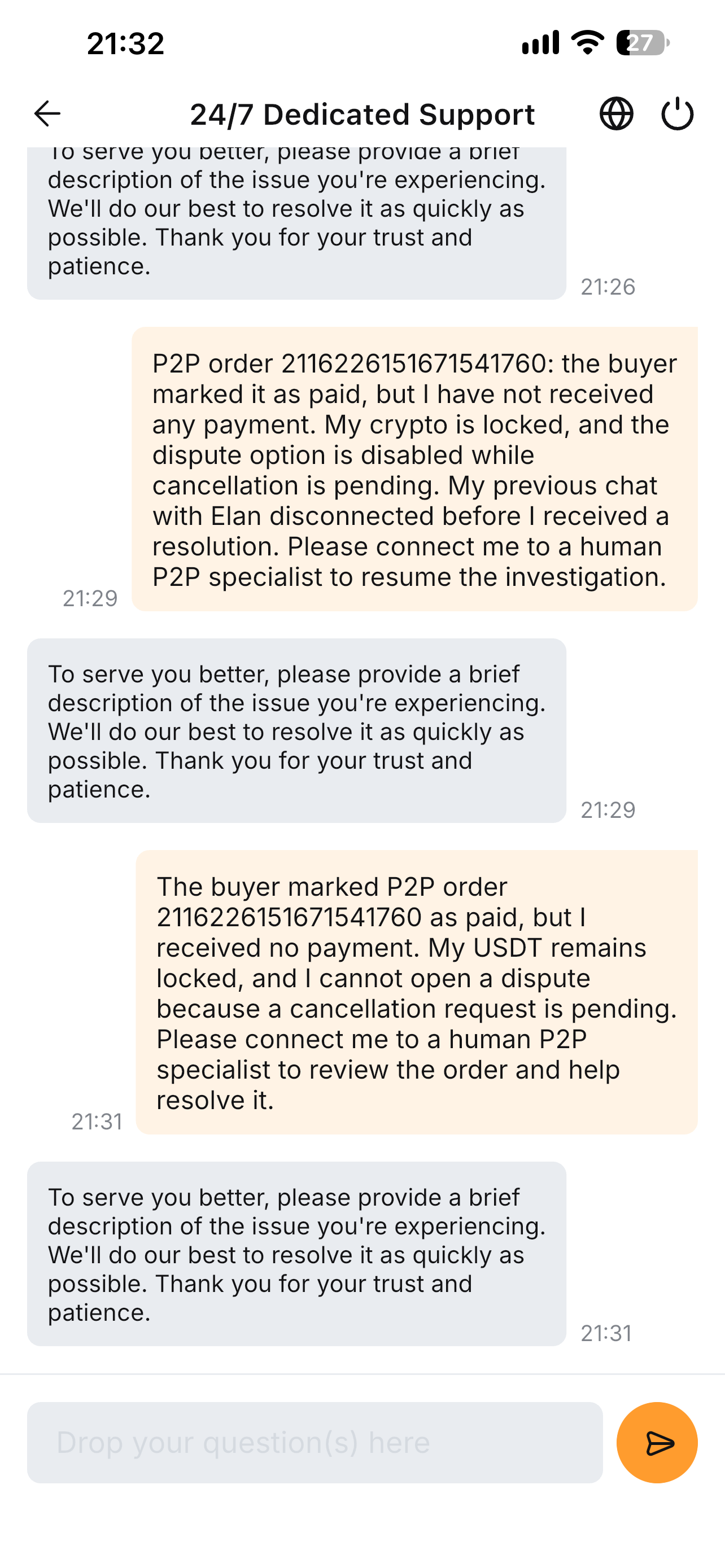
When I returned, I explained that an agent had already started checking. A detailed explanation, a shorter message, and a direct request for a human all produced the same template response.
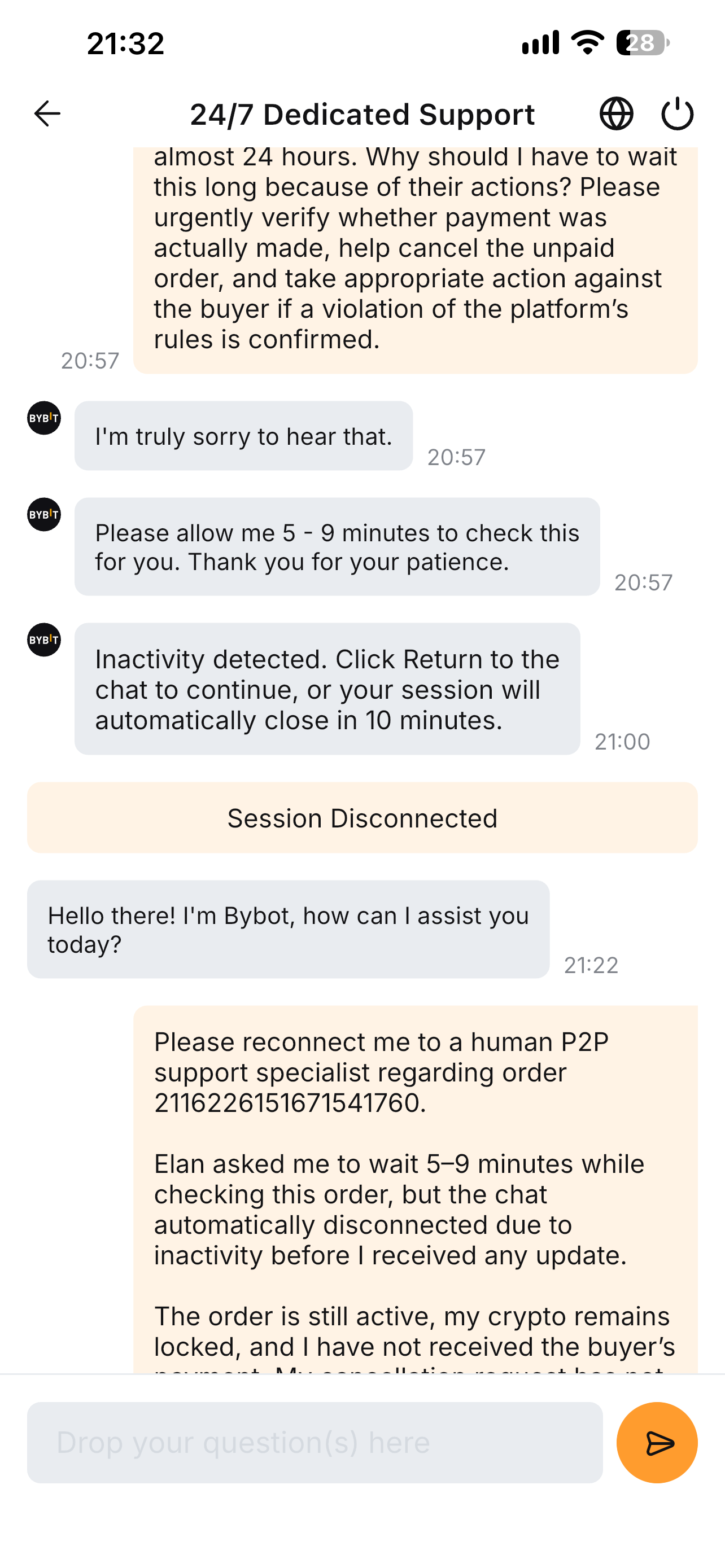
“To serve you better, please provide a brief description of the issue you’re experiencing.”
The earlier messages were still visible in the chat history. From the customer’s perspective, the conversation had been saved, but there was no way to resume work on the existing case.
What we can observe — and what we do not know
The interface cannot establish whether Bybit uses a language model, a scripted bot, or a combination of technologies. It also cannot prove which internal data the automation could access or why the chat ended.
The interaction’s outcome is observable: the system repeated an action already taken, suggested an unavailable function, and did not ensure continuity of the investigation. The following sections discuss engineering approaches to preventing these situations, rather than describing Bybit’s internal architecture.
Conversation history needs a persistent case state
When building business process automation, I connect agent responses to API and CRM data. Support needs four groups of records:
Which actions are currently available
Internal APIs should provide the order status, existing cancellation request, waiting deadline, and appeal availability. If an operation is unavailable, the bot should not present it as an executable next step.
Who reported payment and what supports that claim
A buyer’s “paid” marker, a seller’s report of missing funds, and verified receipt are different facts. An order status alone does not establish that money reached a bank account.
Who continues the investigation
A case needs a persistent identifier, an owner, an action history, and a deadline for the next update. These records must survive a chat disconnection.
What outcome the customer received
Sending an instruction does not resolve the request. For this case, a result could be confirmed cancellation and release of the locked funds, or a clear investigation decision with the next steps explained.
How to handle this kind of request
Link the message to the order
Identify the user, transaction, and existing case. Reconnecting should resume work on the same issue.
Retrieve the current state
Check the cancellation request, restrictions, available actions, and investigations already performed. Build the response from those records.
Stop the repetitive path
If the customer says an instruction does not help, the system should change course. For example, escalate after two unsuccessful attempts; the actual threshold should fit the process.
Give the agent the context
Transfer a concise summary, verified facts, actions already attempted, and the reason for escalation. The customer should not have to reconstruct the conversation.
Preserve the investigation after disconnection
When an agent asks the customer to wait, an inactivity timer should not reset the work. If the connection ends, provide a way to return to the case and receive the result.
Verify the outcome
Before closing the case, compare the result with the customer’s goal. Asset operations must run through approved server-side procedures with authorization checks.
What to measure so replies lead to resolution
- Time to resolutionThe duration of the entire process from the first message.
- Repeat contactsHow often customers return with the same unresolved issue.
- Context repetitionHow many times customers must repeat information already provided.
- Escalation outcomesWhether work continues after a human joins and after a chat disconnects.
Fast replies can reduce the wait for a first response. But repeat contacts and lost context create additional work for agents and undermine customer trust, especially when funds are locked.
Automation service pricing
These are starting prices for individual tasks. Support automation can combine request processing, CRM, APIs, and AI; scope and final pricing are agreed after discussing the process.
| Service | Price |
|---|---|
| Telegram / email notification automation | from $40 |
| Excel / CSV automation | from $50 |
| Report automation | from $60 |
| Request processing automation | from $60 |
| Document and PDF automation | from $75 |
| Product listing automation | from $90 |
| API service integration | from $100 |
| Data synchronization between systems | from $100 |
| Sales team workflow automation | from $125 |
| CRM automation | from $150 |
| AI business process automation | from $200 |
| End-to-end automation system development | from $400 |
Explore business process automation and discuss your requirements
Support automation FAQ
Why does a bot repeat the same instruction?
This can happen when a flow does not account for current case state or does not change course after an unsuccessful attempt. The conversation cannot establish the specific cause at Bybit. In business process automation, I include state checks, records of completed actions, and escalation to a specialist.
Can a bot connect to CRM and internal APIs?
Yes, when the systems provide the required access. Integrations can retrieve case status, available actions, and investigation history. Agent responses should use those records, while the server performs operations with authorization checks. See service integration and process automation.
How can a case survive a disconnected chat?
Store the case independently of the session: assign an identifier and retain its owner, investigation status, action history, and next step. When the customer returns, resume the existing case.
Where should support automation begin?
Start by describing one process: what triggers a request, which data it needs, who owns the next action, and what counts as completion. Then choose integrations and flows. The business process automation page outlines tasks you can start with.
What does automation cost, and can I start small?
Yes. Telegram / email notifications start at $40, request processing at $60, API integration at $100, CRM automation at $150, AI automation at $200, and an end-to-end system at $400. These are starting prices for the respective services; final pricing depends on scope and integrations. The full table is above. Discuss your automation requirements.
Start with the process and integrations
This case illustrates the importance of preserving case state, checking action availability, and assigning someone to continue the investigation. Choosing a language model does not replace that engineering work.
Based on my personal support experience on October 30, 2026. These observations concern one conversation and do not assess all Bybit support processes. The transaction’s outcome beyond the described conversation is not established here.