
MCP + RAG: How AI Turns Data into Clear Answers, Tables and Charts
\nMCP · RAG · telemetry · analytics · AI integrations
RAG helps AI find knowledge in documents and conversations. MCP adds verifiable tools that retrieve measurement history, current project state or an exact financial summary. Together they let users ask ordinary questions and receive answers with numbers, tables, charts and source links.
The central idea: RAG retrieves knowledge, while MCP gives an AI client authorised ways to obtain exact structured data and perform verifiable operations. They solve different parts of the same task.
Why semantic retrieval is not always enough
Retrieval-augmented generation finds relevant passages in a knowledge base and passes them to a language model with the question. It is useful for instructions, documents, notes and conversations because the user does not need to remember a filename or exact wording.
Semantic retrieval is not a universal database. It may miss an exact match, return only part of a long period or mix a historical description with current state. Aggregations and comparisons over thousands of records are better calculated where the source data lives.
- Exact numbersSums, minima, maxima and averages should not be inferred from a few retrieved passages.
- Long periodsEvery measurement, transaction or message cannot fit into model context without loss.
- FreshnessA document can describe the past while a live API reports the current state.
- VerificationAn important conclusion needs the source object, period, units and provenance.
What MCP adds
Model Context Protocol lets an AI client discover specially designed tools and call one with validated parameters. A particular system might expose search_knowledge, get_project, get_inverter_history, get_crypto_monthly_summary or get_telegram_messages. These are implementation examples, not built-in MCP methods.
A tool returns a predictable structure with the period, fields, units, sources and result limits. The AI client can explain and visualise that result without receiving arbitrary SQL or unrestricted server access.
How RAG and MCP work together
Understand the question
The client determines whether it needs documents, exact records, current state or several sources.
Retrieve knowledge
RAG returns relevant passages from instructions, conversations and documentation with their sources.
Obtain verifiable data
MCP calls a narrow tool with an allowed period, project, device or other validated filter.
Reconcile the results
The client separates historical descriptions from current state and does not invent missing facts.
Present the answer
The client produces text, a table or a chart while preserving periods, units and source links.
MCP does not improve semantic retrieval by itself. The benefit comes from routing, additional tools and data that can be checked.
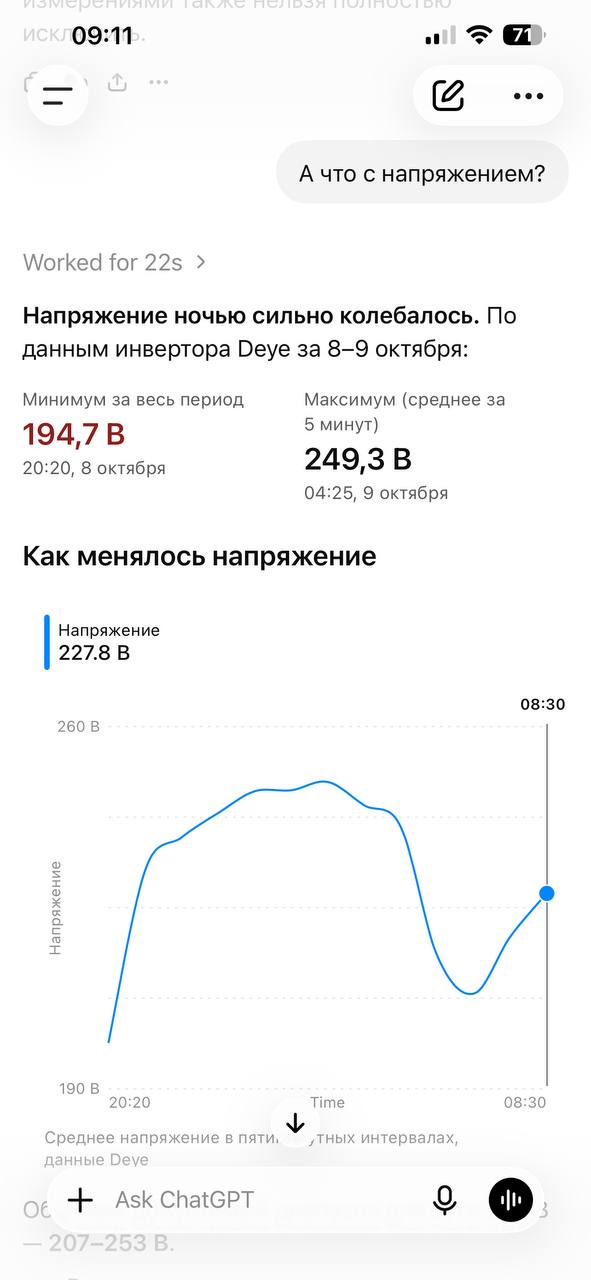
Real example: “What about the voltage?”
Instead of opening a monitoring dashboard, selecting dates and reviewing a long measurement list, the user asks one short question. A history tool retrieves Deye telemetry for the requested period, and the AI client calculates or receives aggregates and builds a visualisation.
These values come from the measurements shown in the real conversation; they were not guessed by the language model. The chart makes changes easier to notice than a long row list.
Important limitation: a minimum and maximum for one selected period are not electrical limits and do not establish a grid fault. A technical conclusion requires the measurement method, duration, equipment settings and applicable standards.
Related engineering material: local Deye inverter monitoring without a cloud service.
Financial analytics: calculate from transactions, not messages
“How much cryptocurrency arrived in September, grouped by coin and network?” requires exact aggregation. RAG can find discussions about payments, but it should not add amounts from arbitrary messages. An MCP tool queries the authorised transaction layer, groups confirmed operations and returns the period and currencies.
| Coin | Network | Confirmed amount | Operations |
|---|---|---|---|
| USDT | TON | from database aggregate | from database aggregate |
| TON | TON | from database aggregate | from database aggregate |
The AI explains changes only after receiving the structured result. All source transactions do not have to enter model context.
Telegram, projects and actual agreements
For “What did we agree with the client last week?”, RAG finds semantically related messages and documents. MCP adds the exact timeline for the authorised conversation, participants, project link and current task state.
The result must distinguish a direct agreement from an inference. If a deadline appears only in a draft or paraphrase, the answer should say so.
Three more useful scenarios
Finding contradictions
RAG retrieves related passages; MCP obtains exact messages, document versions and metadata. The answer shows conflicting deadlines and cites both sources.
Data-quality checks
A structured query selects projects without an owner and overdue tasks, while RAG adds explanations from procedures and conversations.
Change history
Project events, messages and updated knowledge become one “What changed in seven days?” report without confusing old records with current state.
RAG alone and RAG + MCP
| Capability | RAG alone | RAG + MCP |
|---|---|---|
| Semantic document search | Yes | Yes |
| Conversation search | Yes, when indexed | Yes, plus exact messages and metadata |
| Financial aggregates | Requires another mechanism | Specialised tool |
| Historical telemetry | Limited | Measurement API with periods and units |
| Current state | Depends on index freshness | Live tool |
| Charts and tables | When data and client support exist | When data and client support exist |
| Source reconciliation | Possible | Easier through domain tools |
| Verification | Document links | Documents and structured results |
Security: allowed operations, not full access
- Least privilegeRead-only by default; writing only through separate confirmed operations.
- AuthorisationPublic content, employee data and management analytics use different access levels.
- Result limitsThe server validates periods, fields, row counts and accessible projects.
- Personal dataScreenshots are redacted and conversations are returned only to authorised users.
- ProvenanceResponses preserve identifiers, dates, links and the origin of each result.
- Prompt injectionDocument text is untrusted data and cannot expand tool permissions or override system rules.
The AI receives no passwords, API keys, arbitrary SQL or unrestricted infrastructure access. Even if a malicious instruction appears in a document, the server must independently enforce permissions and validate every call.
What to design first
Do not begin by “connecting the entire database to AI.” Start with two or three verifiable workflows: the user's question, the source of truth, the smallest required tool and a way to check the result. Define freshness, units, aggregation rules and incomplete-result behaviour in advance.
For public MCP fundamentals, see “MCP for Websites: Audits, Product Selection and Business Data for AI Clients”. The AI agents and RAG systems service covers knowledge bases and semantic retrieval.
Frequently asked questions about MCP and RAG
How is MCP different from RAG?
RAG retrieves relevant passages from documents and knowledge bases. MCP gives an AI client controlled tools for obtaining exact data and performing authorised actions. They can work together in the same system.
Can MCP and RAG connect to an existing CRM or database?
Yes. A separate integration layer normally exposes narrow methods with authorisation and result limits. There is no need to migrate the entire CRM or give the model direct database access.
Which data sources can be connected?
Documents, corporate knowledge bases, CRM systems, online stores, Telegram archives, internal APIs, financial operations and telemetry. The exact set depends on the questions the system must answer.
Will AI be able to see all company data?
No, when the architecture is designed correctly. The MCP server checks the user, allowed projects, fields, period and response size. Sensitive sources can use read-only access, masking and call logs.
How is answer accuracy verified?
Answers preserve document links, object identifiers, periods, units and provenance. Numerical summaries are calculated in the database or domain service rather than guessed by the language model.
Can the system produce tables and charts?
Yes. An MCP tool returns structured results and the AI client presents them as text, a table or a chart. Fields, units, aggregation rules and result limits should be defined in advance.
Is there a similar project in the portfolio?
What is the best way to start?
Begin with one or two verifiable workflows: define the user's question, source of truth, access rules and response format. New sources and actions can be added after the pilot without rebuilding the entire system.
Your data may already be more useful than it appears
The question is how easily AI can work with it. I build MCP servers and RAG systems for existing knowledge bases, CRM systems, online stores, Telegram archives and internal information systems.